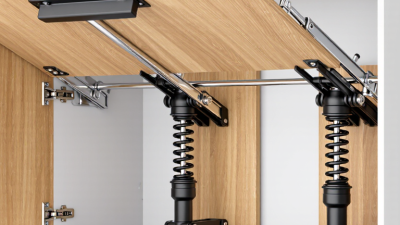
Choosing the best China supplier for a Cabinet Door Lift Support requires more than comparing catalog prices. The right partner should understand cabinet weight, opening angles, door materials, and daily use. A support that works on a light plywood door may fail on solid wood or glass. Small details matter.
Experienced buyers often begin with a sample. They measure the door, hinge position, required lifting force, and available cabinet space. They also inspect the spring, mounting brackets, screws, and surface finish. Smooth movement is important. So is controlled closing.
A reliable Chinese manufacturer should provide clear load ratings, installation drawings, material information, and quality inspection records. Ask about production experience, testing procedures, traceability, and after-sales support. Factory visits, video inspections, and independent sample testing can strengthen confidence. Certifications may help, but they should match the actual product and market requirements.
Pricing can be attractive. Quality still needs proof.
The best supplier is not always the largest factory. It may be a focused manufacturer with stable production, responsive engineers, and consistent batch control. Communication also reveals practical competence. Can the supplier explain why a support needs a specific force rating? Can they adjust the design without weakening safety?
No supplier fits every cabinet project. Our first choice may also prove unsuitable after real testing. That is why careful sampling, installation feedback, and documented improvements remain essential. This guide examines the factors that distinguish a dependable China Cabinet Door Lift Support supplier from a merely inexpensive option.
What Is a Cabinet Door Lift Support?
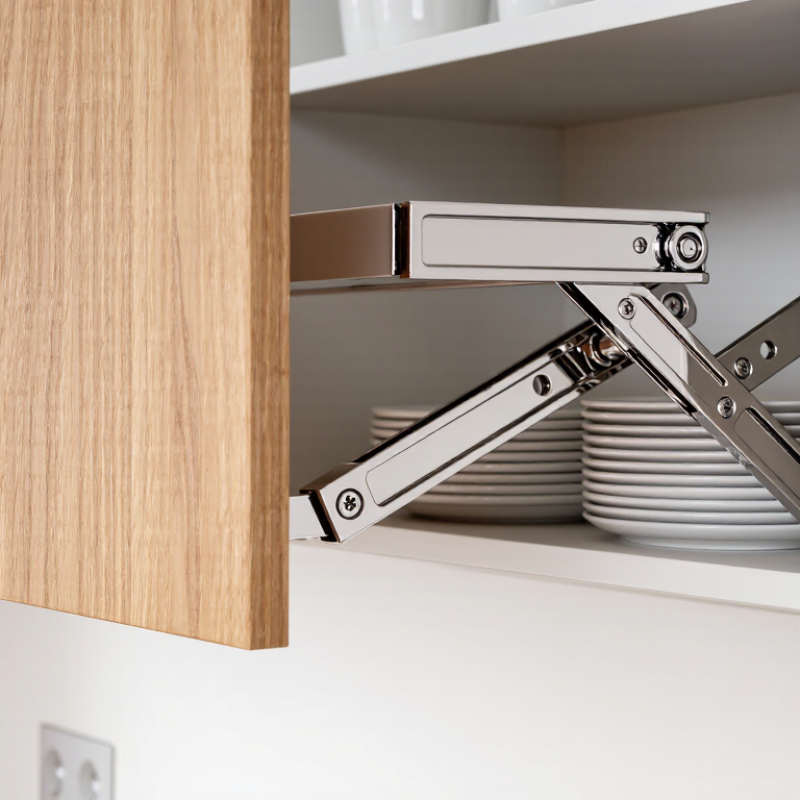
A cabinet door lift support is a mechanical fitting that helps raise, hold, and control an upward-opening door. It usually combines a gas spring, mounting brackets, and a pivoting joint. When installed correctly, it reduces the door’s weight during opening. It also helps prevent sudden drops near eye level.
In practical installation, support selection depends on door weight, width, material, and hinge position. A small 450 mm acrylic door needs different assistance than a 900 mm solid-wood door. Excessive force can make the door difficult to close. Insufficient force may cause drifting or falling. Houzz’s 2024 U.S. Kitchen Trends Study reported that 76% of renovating homeowners upgraded their cabinets. This suggests that usability hardware remains important during cabinet improvement projects. However, cabinet dimensions vary widely, so reported renovation trends cannot replace a load calculation.
Tips: Measure the complete door assembly, including the handle. Check the supplier’s force range and mounting diagram. Install two supports on wide doors when the design requires balanced movement. Test the door slowly before daily use. A door that stops smoothly is safer than one that snaps upward. Small alignment errors matter. In field work, I have seen a support fail early because screws entered thin board edges. That mistake is easy to repeat, and worth rethinking. Inspect screw tightness and joint movement after several opening cycles.
Cabinet door lift supports use controlled force to hold an upward-opening door safely. A gas spring contains pressurized gas inside a sealed cylinder. When the door rises, the gas pushes against a piston and reduces the effort needed from your hand. The support also slows movement near the open position. This prevents the door from dropping suddenly, although performance depends on door weight, size, and installation angle.
In practical installation, the support should match the door’s weight and hinge layout. Mounting points must be measured carefully on both sides. A few millimeters can change the lifting force significantly. If the support is too strong, the door may spring upward. If it is too weak, the door may drift downward. The first adjustment is rarely perfect. Recheck the screws after several opening cycles, especially when the cabinet uses thick wood or glass panels.
Tips: Open the door slowly during testing. Keep fingers away from hinge gaps. Install supports in pairs when the door is wide or heavy. Check for smooth resistance, loose fittings, and unusual sounds. Do not rely only on the printed force rating; real door balance can differ. Humidity, temperature, and repeated use may also affect movement over time. A careful supplier should provide load guidance, mounting measurements, and material details before production.
This chart shows the estimated support force required for different cabinet door weights. The calculation uses standard gravity (9.81 m/s²), a 250 mm distance from the hinge to the door’s center of mass, and a 100 mm effective support lever arm. The total force is shared equally by two lift supports, so each support carries approximately half of the calculated load.
Choosing a reliable cabinet door lift support supplier requires more than comparing prices. The supplier should understand cabinet weight, opening angle, door size, and daily usage. These details affect the required gas force and support position. A suitable product should open smoothly and hold the door steadily without sudden movement.
Material quality matters. Look for corrosion-resistant steel, firm mounting brackets, and durable ball joints. A dependable supplier should provide force charts, installation drawings, sample testing, and clear product specifications. Factory quality control should include cycle tests, leakage checks, load tests, and dimensional inspections. Ask for inspection records, not only attractive photographs. Small details matter.
Communication is another key feature. Reliable suppliers answer technical questions clearly and confirm tolerances before production. They should also explain lead times, packaging, replacement parts, and after-sales handling. No supplier is perfect. That deserves honest discussion. A slightly different cabinet material may change performance, even when the support matches the listed weight. Practical testing remains necessary. A supplier willing to review failed samples and improve the design is often more trustworthy than one promising flawless results. Clear feedback, consistent production, and careful documentation build confidence over time.
China Best Cabinet Door Lift Support Supplier?
How to Choose the Best Cabinet Door Lift Support Supplier
Choosing a cabinet door lift support supplier requires more than comparing prices. Check the supplier’s product experience, engineering process, and quality controls. A reliable supplier should explain load ratings clearly. Ask whether testing covers opening cycles, temperature changes, corrosion resistance, and mounting strength. Request material details, inspection records, and samples before placing a large order.
The lift support must match the door’s weight, width, and opening angle. An unsuitable force rating can make the door slam or stay open poorly. During sample testing, I check movement by hand and listen for uneven friction. Small noises can reveal weak fittings. I once focused too much on polished packaging and missed a loose mounting bracket. That mistake changed my evaluation process.
Tips: Compare at least three suppliers. Ask for recent test reports and production photos. Confirm tolerance standards, packaging protection, replacement parts, and delivery procedures. Discuss customization carefully, because special lengths or brackets may increase testing time. A factory that welcomes technical questions is often easier to trust. Still, confidence should come from evidence, not fast promises.
| Evaluation Dimension | Recommended Selection Benchmark | Relevant Technical Data | Verification Method | Suggested Weight |
|---|---|---|---|---|
| Product Type | Choose a lift support that matches the cabinet opening direction and door construction. | Common options include gas-spring, friction, stay, and spring-assisted mechanisms. | Compare the supplier’s drawings with the cabinet door layout and hinge position. | 10% |
| Load and Force Matching | The selected force should be calculated from door weight, center of gravity, hinge location, and the number of supports. | Force is normally specified in newtons (N); 1 kgf is approximately 9.81 N. Avoid selecting by door weight alone. | Request a force chart, installation dimensions, and a sample test using the actual door material. | 18% |
| Dimensional Compatibility | The support must fit the cabinet side panel, door thickness, hinge geometry, and available mounting space. | Check extended length, compressed length, stroke, mounting-hole spacing, bracket thickness, and fixing diameter. | Approve a dimensioned drawing and verify a first article before bulk production. | 15% |
| Material and Surface Finish | Use materials and finishes suitable for indoor humidity, kitchen vapour, and repeated handling. | Typical components may include steel or stainless steel rods, steel cylinders, polymer seals, and plated or coated brackets. | Request material declarations, coating specifications, and surface-finish samples. | 10% |
| Corrosion Resistance | Select a finish that matches the expected moisture and cleaning environment. | Salt-spray test duration is meaningful only when the test method, substrate, coating, and acceptance criteria are stated. | Review an independent or laboratory test report and confirm the applicable test standard. | 8% |
| Cycle-Life Performance | The product should maintain controlled opening and closing over the expected service life. | Evaluate cycle count, test load, opening angle, speed, temperature, and allowable force loss together. | Request a complete endurance-test protocol and production batch records. | 15% |
| Safety and Motion Control | Prioritize stable movement, secure mounting, controlled closing, and protection against sudden door drop. | Check end-position stability, damping behaviour, bracket retention, and pinch-point risk. | Conduct functional, overload, installation-strength, and misuse tests on assembled cabinets. | 12% |
| Quality Control System | Choose a supplier with documented incoming, in-process, and final inspection procedures. | Important checks include force output, dimensions, leakage, appearance, thread quality, and mounting strength. | Request inspection plans, sampling levels, nonconformance procedures, and recent inspection records. | 8% |
| Sampling and Customization | The supplier should provide samples and adjust force, dimensions, brackets, or packaging when required. | Confirm sample quantity, sample lead time, tooling charges, revision control, and approval stages. | Use a signed technical specification and approve a pre-production sample. | 6% |
| Packaging and Delivery | Packaging should protect rods, brackets, threads, and surface finishes during international transport. | Review carton dimensions, units per carton, gross weight, moisture protection, labels, and delivery schedule. | Approve a packaging sample and define delivery terms, inspection points, and shipment documents. | 5% |
| Technical Support and Warranty | Select a supplier that provides installation guidance, troubleshooting support, and a clearly defined claim process. | Confirm warranty period, covered defects, response time, replacement policy, and spare-part availability. | Review the written warranty terms and test the supplier’s response during the sample stage. | 3% |
| Total Supplier Evaluation Weight | 100% | |||
Choosing a cabinet door lift support requires more than comparing price and appearance. Installation accuracy, maintenance access, and material quality determine its service life.
Before drilling, measure the door thickness, weight, and hinge position. Use a template when available, but verify every measurement manually. Both supports must sit at matching heights and remain parallel. A small offset can create uneven lifting force. Tighten screws firmly, without crushing particleboard. Do not force the door. After fitting, open it slowly and check for rubbing, sudden drops, or excessive resistance. These practical checks often reveal errors that drawings cannot show.
Maintenance should include a six-month inspection in kitchens, workshops, or other dusty areas. Check loose screws, bent brackets, unusual noise, and oil leakage. Wipe exposed surfaces with a dry or lightly damp cloth. Avoid aggressive cleaners near seals and moving joints. Quality evaluation should cover tested load capacity, corrosion resistance, spring or gas pressure consistency, and cycle-test records. A reliable supplier should provide clear dimensions, installation instructions, inspection data, and replacement guidance. In my fitting experience, supports sometimes perform poorly because the selected load rating ignores the door handle and stored contents. That mistake is easy to make. It also deserves honest review. A better specification includes a reasonable safety margin, while avoiding excessive force that makes the door difficult to close.