Home hardware manufacturer 18+ years

  • Facebook
  • linkedin
  • TikTok
  • youtube
  • Twitter
Leave Your Message

What Is a Hidden Cabinet Hinge and How Does It Work?

A Hidden Cabinet Hinge is more than a small metal fitting behind a door. It controls movement, alignment, closing pressure, and the visual cleanliness of modern cabinetry. When the door opens, the hinge uses linked arms and pivot points to guide its path. When it closes, adjustment screws help position the door with millimeter-level precision. That quiet movement is engineered, not accidental.

Blum founder Herbert Blum once said, “We want to make furniture better.” That principle explains why concealed hinge design focuses on both appearance and daily performance. A quality hinge usually includes a mounting plate, hinge cup, adjustment mechanism, and sometimes an integrated soft-close damper. These parts work together inside a cabinet space that may be only a few centimeters wide.

The installation is less forgiving than it appears. Door thickness, overlay, cabinet squareness, and screw placement all matter. A small error can create an uneven gap or a door that rubs against its neighbor. I have found that many explanations make the mechanism sound perfectly simple. It is not always simple in practice. Older cabinets may have warped panels, loose mounting holes, or inconsistent materials. This article examines how a Hidden Cabinet Hinge works, what its internal parts do, and how installers adjust it for smooth, reliable operation. It also considers common mistakes, because even a well-designed hinge cannot fully correct poor measurement or a distorted cabinet box.
What Is a Hidden Cabinet Hinge and How Does It Work?

Definition and Purpose of a Hidden Cabinet Hinge

A hidden cabinet hinge is a concealed metal mechanism mounted inside the cabinet door and frame. Its purpose is simple: hold the door securely while keeping the hardware out of sight. When the door closes, only a clean, uninterrupted panel remains visible. Most concealed hinges use a small cup drilled into the door and an adjustable mounting plate inside the cabinet.

The hinge controls opening, closing, alignment, and door spacing. Many models allow vertical, horizontal, and depth adjustments. These settings help correct uneven gaps after installation. In real cabinet work, a one-millimeter error can become obvious across a full row of doors.

The 2024 U.S. Kitchen Trends Study reported that 76% of renovating homeowners upgraded their cabinet doors, showing why reliable hinge adjustment matters during remodeling. Industry installation guidance also commonly recommends testing door movement before final screw tightening. That practical step is often skipped. It should not be.

Concealed hinges can support soft-closing action, reducing impact noise and protecting door edges. Their performance depends on door weight, overlay size, screw placement, and cabinet material. A hidden hinge is not automatically better. Poor drilling or incorrect adjustment can create rubbing, sagging, or uneven reveals. The European standard EN 15570 classifies requirements for furniture hinges, including durability and closing performance. Therefore, buyers should check the hinge’s tested cycle rating, load guidance, and adjustment range instead of judging appearance alone.


Main Components and How They Connect

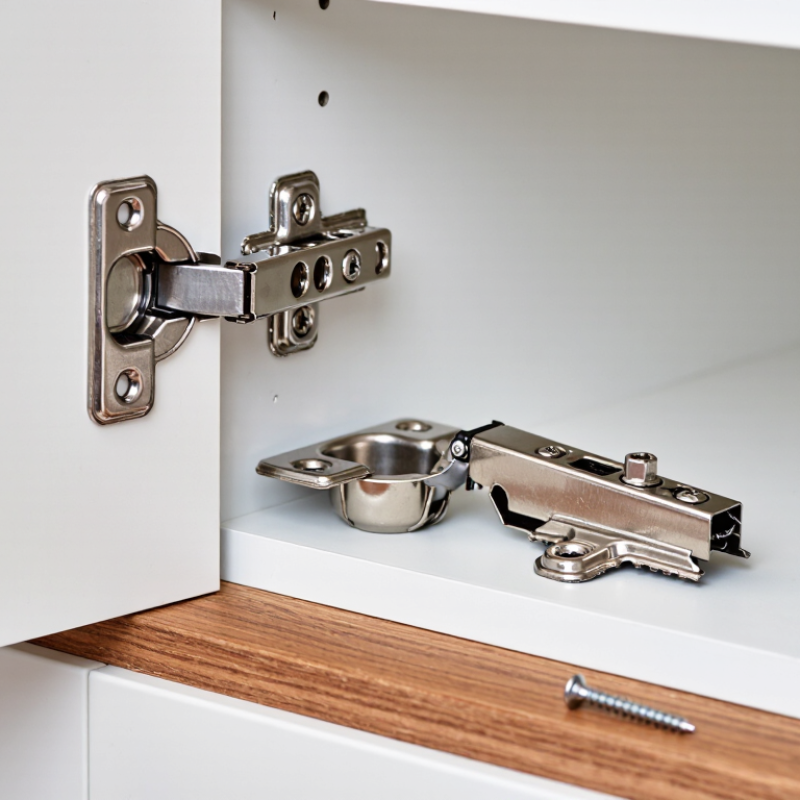
A hidden cabinet hinge sits inside the door and cabinet frame, so the hardware remains mostly invisible when closed. It usually includes a hinge cup, hinge arm, mounting plate, and adjustment screws. The cup fits into a round recess drilled near the door edge. The hinge arm connects this cup to the mounting plate inside the cabinet. The plate attaches to the cabinet wall with screws. Together, these parts create a controlled pivot.

When the door opens, the hinge cup rotates through the arm’s joint. The mounting plate keeps the hinge aligned with the cabinet box. Small screws adjust the door from side to side, forward and backward, or up and down. These movements control the gap between doors and surrounding panels. Some hinges also contain a damping mechanism for quieter closing. However, soft closing is not included in every design.

Tips: Measure the cup position carefully. A few millimeters can change the door gap. Use a drill guide when possible, and tighten screws gradually. I have found that forcing a misaligned door usually makes the problem worse. Check the cabinet frame for unevenness before blaming the hinge. Door weight, panel thickness, and opening angle also affect hinge performance. Test the door several times before final tightening. Adjustment is normal, not a sign of poor workmanship.

How a Hidden Hinge Operates During Door Movement

What Is a Hidden Cabinet Hinge and How Does It Work?

A hidden cabinet hinge sits inside the cabinet frame and behind the closed door. Its hinge cup is bored into the door’s inner surface. A mounting plate connects the hinge arm to the cabinet side. When the door opens, the hinge arm rotates around several linked pivots. This movement lets the door swing outward before moving sideways, preventing contact with the cabinet frame. During closing, the linkage guides the door back into alignment. Many concealed hinges also include a small damper. It slows the final movement and reduces slamming.

Harvard University’s Joint Center for Housing Studies projected U.S. remodeling and maintenance spending could reach about 485 billion dollars by 2024. That level of renovation increases demand for hardware that performs consistently. Industry testing standards, including ANSI/BHMA A156.9 and EN 15570, assess hinge durability, strength, and repeated operation. Real kitchens are less controlled. Doors carry uneven loads, and loose screws can change the movement path. That assumption needs checking. A hinge may be correctly installed but poorly adjusted.

Tips: Keep the hinge cup and mounting plate tight. Use the adjustment screws for height, depth, and side alignment. Leave a small, even gap around the door. Check that the damper engages near closure, not halfway through the swing. Dust and paint buildup can restrict motion. A practical inspection should include several slow openings and firm, normal closing cycles. Watch the gap, sound, and resistance. Small differences often reveal larger installation problems.

Common Types and Adjustment Mechanisms

A hidden cabinet hinge sits inside the cabinet door, so the hardware remains almost invisible when closed. It connects the door to the cabinet body and controls opening, closing, and alignment. Common types include full-overlay, half-overlay, and inset hinges. Frameless cabinets often use different mounting plates than face-frame cabinets. Clip-on models save installation time, while screw-mounted hinges can feel more secure during heavy use.

Most concealed hinges offer three-way adjustment. The side screw moves the door left or right. The depth screw brings the door closer to, or farther from, the cabinet box. Height adjustment usually comes from loosening the mounting-plate screws. Soft-close mechanisms slow the final movement and reduce impact noise.

According to the 2024 Houzz U.S. Kitchen Trends Study, 76% of renovating homeowners upgraded their cabinet doors. That figure shows why accurate hinge selection matters. Yet, small gaps still appear in real installations. Wood movement, uneven boxes, and rushed drilling can all affect alignment.

Tips:

Adjust one hinge at a time, using a short screwdriver. Mark the original screw position first. Keep a 2–3 millimeter gap between adjoining doors. Avoid forcing the soft-close mechanism.

The Freedonia Group identifies cabinet hardware as a mature, replacement-driven category, so durability deserves attention alongside appearance.

In practice, a hinge may look correct but still bind after several openings. Test the door repeatedly before final tightening.

Installation Factors, Benefits, and Limitations

A hidden cabinet hinge sits inside the door and frame, so the hardware disappears when the door closes. Its pivoting arms transfer movement through a compact mechanism, allowing the door to open, close, and adjust. In workshop fitting, I have found that alignment matters more than hinge appearance. A few millimeters can change the reveal around the door. Small errors show quickly. Measure twice.

Installation requires accurate measurements for door thickness, overlay, and cup-hole position. The cabinet side must be strong enough to hold the mounting plate and repeated opening forces. A drill guide helps keep the cup hole centered and at a consistent depth. Too deep, and the screw may weaken the door. Too shallow, and the hinge may sit proud. Installers should check clearance near shelves, drawers, and neighboring doors. After mounting, adjust the hinge slowly in height, depth, and side-to-side movement. Do not force the screws.

The main benefit is a clean, uninterrupted cabinet face. Many concealed hinges also offer soft closing and useful adjustment after installation. They suit kitchens, offices, and storage units where visible hardware feels distracting. However, they are not ideal for every cabinet. Very heavy doors may need stronger hardware or additional support. Thin, brittle, or warped panels can limit reliable installation. Access is another limitation; repairs may require removing shelves or emptying the cabinet. I sometimes expect adjustment to solve every problem, but it cannot correct a twisted cabinet box. It needs precision.

What Is a Hidden Cabinet Hinge and How Does It Work? - Installation Factors, Benefits, and Limitations

Data Dimension Typical Information How It Works or Why It Matters Installation or Use Considerations
Definition A concealed or European-style cabinet hinge mounted inside the cabinet and door. The hinge body is hidden when the cabinet door is closed, creating a clean, uninterrupted exterior. Confirm that the door, cabinet side, mounting plate, and hinge cup are compatible before drilling.
Main Components Hinge cup, hinge arm, mounting plate, screws, and adjustment mechanisms. The cup attaches to the door, while the arm and plate connect the door to the cabinet box. Use the supplied mounting hardware or equivalent hardware suitable for the cabinet material.
Common Hinge-Cup Diameter Approximately 35 mm for many full-size concealed hinges; smaller hinges may use smaller cups. The cup is recessed into the back of the door and provides a pivot point for the hinge mechanism. Check the manufacturer’s drilling specification; cup depth and setback are not universal.
Typical Cup Depth Often about 11–13 mm, depending on hinge design. The recessed cup allows the hinge to sit within the door rather than on the visible face. Do not drill deeper than the door material permits; thin doors require particular care.
Opening Angle Common designs open approximately 95°–110°; specialized hinges may open farther. The hinge geometry determines how far the door can swing before contacting the cabinet or an adjacent door. Choose the angle according to clearance, drawer position, corner cabinets, and surrounding walls.
Door Overlay Full overlay, half overlay, and inset configurations are common. The configuration controls how much the door covers the cabinet side or whether it sits inside the opening. Measure the cabinet opening and door relationship before selecting the hinge arm style.
Adjustment Directions Many modern concealed hinges provide side-to-side, front-to-back, and vertical adjustment. Adjustment screws reposition the door after installation to improve alignment and reveals. Make small, alternating adjustments on all hinges to avoid twisting the door or stressing the screws.
Soft-Closing Function Some hinges include an integrated damper; others require a separate soft-close device. A damper slows the final part of the closing movement and reduces slamming noise. Verify that the damper is suitable for the door weight and that it can be disabled if necessary.
Number of Hinges Two hinges may suit smaller, lighter doors; taller or heavier doors commonly require three or more. Additional hinges distribute the door load and help limit sagging and twisting. Use the hinge manufacturer’s load guidance; door height, width, thickness, and material all affect requirements.
Door Material Compatibility Commonly used with solid wood, plywood, particleboard, MDF, and laminated panels when properly prepared. The hinge transfers opening forces through the cup and screws into the door and cabinet side. Weak or damaged board edges may need reinforcement, repair, or specialized fasteners.
Basic Installation Sequence Mark positions, bore the cup hole, attach the hinge, install the mounting plate, hang the door, and adjust. Accurate positioning allows the hinge components to operate along their intended pivot path. Use a drill guide or concealed-hinge jig where possible, and test-fit before final tightening.
Required Tools Tape measure, pencil, drill, correct boring bit, screwdriver or driver, square, and clamps as needed. Accurate measurement and controlled drilling are essential for consistent door gaps. Use the correct bit size and speed for the door material to reduce tear-out and overheating.
Visible Appearance The hinge is largely hidden when the door is closed. The design emphasizes flat, uninterrupted cabinet fronts without exposed knuckles or leaves. The interior hardware still occupies space and may be visible when the door is open.
Key Benefits Clean appearance, adjustable alignment, wide availability, and optional soft closing. Adjustability makes it easier to correct minor installation tolerances and maintain even reveals. Select a hinge based on function and cabinet construction rather than appearance alone.
Main Limitations Requires precise drilling, adequate door thickness, and sufficient interior clearance. Incorrect cup placement or unsuitable overlay selection can cause binding, uneven gaps, or poor closing. Repairing stripped screw holes or misaligned bores may require plugs, reinforcement, or door replacement.
Maintenance Periodically inspect screws, mounting plates, alignment, and damper operation. Loose hardware or gradual door movement can lead to rubbing, sagging, and uneven reveals. Tighten loose screws carefully and avoid over-tightening, which can damage board materials.

Note: Dimensions, opening angles, load capacity, and installation requirements vary by hinge design and cabinet construction. Always verify the specific product specification before drilling or fitting.