10 Best Wardrobe Rail Brackets for Heavy Duty Storage?
A wardrobe is more than a row of hangers. It is a daily load-bearing system. Coats, denim, handbags, and seasonal clothing can create surprising pressure on one small support point. That is why choosing the right Wardrobe Rail Bracket requires more than comparing prices or polished photographs.
Market research reflects this practical demand. Grand View Research identifies rising interest in home-organization products, supported by smaller living spaces and renovation activity. The Freedonia Group also links storage-product demand with remodeling and replacement projects. These reports describe a growing market, but they do not prove that every bracket is reliable. Testing still matters. Look for stated load capacity, steel thickness, screw quality, corrosion resistance, and compatibility with the rail diameter. A bracket that holds 30 kilograms in a laboratory may perform differently on plasterboard with short screws.
Closet designer Lisa Adams offers a useful design principle: “A well-designed closet should make getting dressed easier, not more complicated.” The same idea applies to hardware. Installation should be clear. The rail should sit level. The wall should not sound hollow under a loaded bracket. Small details matter.
This guide examines ten heavy-duty options through a practical lens. It considers strength, finish, adjustability, installation effort, and long-term value. No bracket is perfect. Some impressive models still need better anchors or wider spacing. That is easy to overlook. Real storage is less tidy than a showroom, so dependable support deserves attention before appearance.
What Makes a Wardrobe Rail Bracket Heavy Duty?
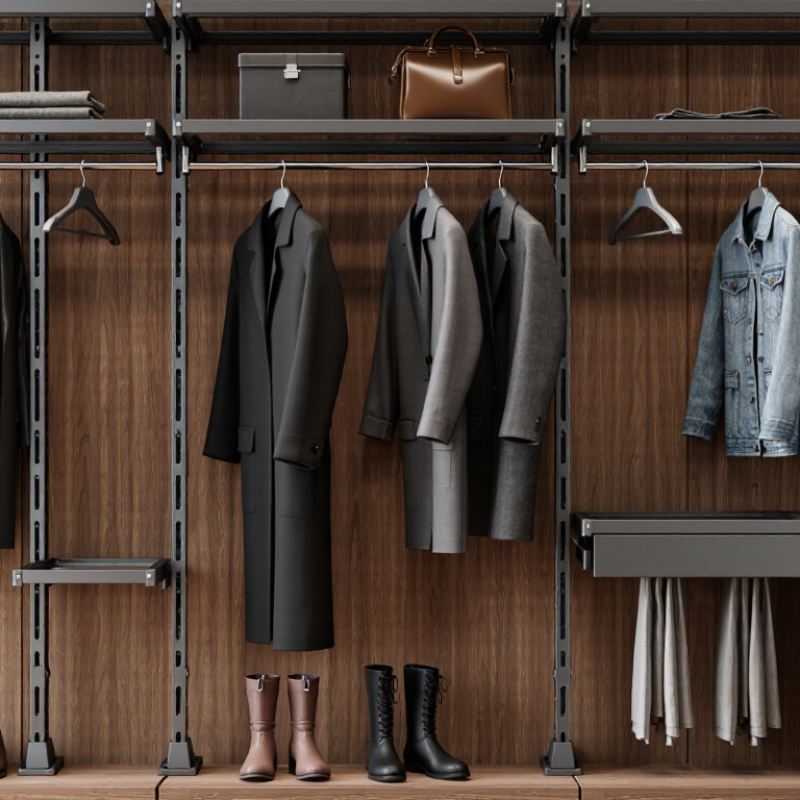
A heavy-duty wardrobe rail bracket is more than a thick piece of metal. It must carry clothing weight without twisting, sagging, or pulling from the cabinet wall. ISO 7170:2005 evaluates storage furniture through static strength, durability, and stability tests. These principles also matter when selecting rail supports. A reliable bracket should have a stated working load, not only a dramatic breaking load.
Material thickness matters. So does the fixing method. Steel brackets with reinforced corners usually resist bending better than flat, lightweight designs. The screws must enter solid timber, a suitable panel, or a properly supported wall. Plasterboard alone is rarely enough for loaded rails. Leave room for dynamic weight, too. Hangers move. Coats swing. Children may pull the rail.
The U.S. Consumer Product Safety Commission reported about 71,300 furniture tip-over injuries treated in emergency departments from 2018 to 2022. That figure concerns furniture broadly, but it highlights a related risk: overloaded storage can shift or detach. A strong bracket should therefore work with a secure cabinet structure and, where necessary, anti-tip protection. In practical fitting, I would test the rail gradually and inspect screw movement after several days. This is not perfect. Load estimates are often optimistic. A bracket rated for 100 kilograms may perform poorly when installed into weak board with short screws. Manufacturing tolerances, wall condition, and uneven loading still deserve careful attention.
Key Factors for Choosing the Right Rail Bracket
A heavy-duty wardrobe rail begins with the bracket, not the rail itself. Choose a bracket with a tested load rating that exceeds your expected clothing weight. Winter coats, shoes, and storage boxes add weight quickly. A useful safety margin is at least 25 percent.
Measure the rail diameter and bracket depth carefully. A loose fit can let the rail twist or slip. Check the wall material before buying. Solid wood, concrete, and plasterboard require different fixings. For plasterboard, use suitable anchors or attach the bracket to a wall stud. The screw length also matters. Short screws may look neat, but they provide weak support.
I once judged brackets by thickness alone. That shortcut was wrong. The mounting plate, screw holes, and metal quality matter just as much. Look for smooth edges, firm welds, and a finish that resists humidity. In a damp room, untreated metal may develop rust around the screw holes. Keep longer rails supported at regular intervals, especially when garments hang unevenly. Test the installed rail gently before loading it. Then add weight gradually. Even careful measurements can fail when the wall is uneven or the fixings are poorly seated.
10 Best Wardrobe Rail Brackets for Heavy-Duty Storage
Comparison of common wardrobe rail bracket specifications by practical load capacity per pair. Material strength, fixing method, rail diameter, wall condition, corrosion resistance, and adjustability are key factors when choosing a bracket.
Capacity values are reference benchmarks in kilograms per pair. Always confirm the tested rating and use suitable wall anchors and screws for the installation surface.
Maintenance and Safety Checks for Long-Term Use
Heavy-duty wardrobe rail brackets can look secure while their fixings slowly loosen. In my experience, small movement is the earliest warning sign. Gently press the rail and watch for flexing, twisting, or wall movement. Do not guess.
Check every screw, anchor, and joint with the correct hand tool. Tighten loose fixings carefully, but avoid crushing the wall material. Confirm that the brackets remain level, especially after adding winter coats or storage boxes. Never treat the maximum load rating as a daily target. Distribute clothing evenly across the rail. Heavy items should stay close to the strongest supports.
Every three months, remove dust and inspect the metal under bright light. Look for rust, hairline cracks, bent flanges, and enlarged screw holes. Rust near a fixing deserves immediate attention. Replace damaged hardware instead of covering it with paint. If the wall feels soft, investigate the substrate before tightening anything. A stronger bracket cannot compensate for weak plasterboard or unsuitable anchors.
I once ignored a slight downward curve because the rail still held clothing. That was a poor judgment. The curve increased after several weeks. Rechecking the installation helped reveal uneven loading and one loose fixing. After repairs, test the rail gradually with light garments before restoring full storage. Keep children away during testing, and never climb, hang, or pull on the rail. Record inspection dates, because memory is less reliable than a simple note.