Home hardware manufacturer 18+ years

  • Facebook
  • linkedin
  • TikTok
  • youtube
  • Twitter
Leave Your Message

2026 Top Gas Spring Cabinet Support Suppliers

A Gas Spring Cabinet Support may look like a small fitting, but its force rating shapes how a cabinet feels every day. A lift-up door should rise smoothly, pause safely, and close without a sharp drop. Buyers comparing suppliers need more than catalog claims: they should check load ranges, cycle-test methods, materials, installation dimensions, and warranty terms.

Industry reports offer useful context, but their scope matters. Grand View Research’s furniture-market analysis tracks broader furniture demand, while market research on gas springs covers applications beyond cabinets. Neither should be read as a cabinet-support supplier ranking. Treat market figures as context, then verify product specifications and test evidence directly. Small details matter: a 100-newton rating, a 10,000-cycle test, or a few millimeters of mounting offset can change performance.

Design researcher Don Norman offers a relevant usability principle: “Good design is actually a lot harder to notice than poor design.” His observation is not a gas-spring performance claim; it is a reminder to assess the user experience. This guide examines 2026 suppliers through that practical lens, comparing product range, technical documentation, customization, quality controls, and service. A polished catalog is not proof. Ask for the test conditions. Check the fit before ordering at scale. Some supplier data may remain difficult to compare, so buyers should record assumptions and verify them before making a final choice.
2026 Top Gas Spring Cabinet Support Suppliers

Cabinet Gas Spring Basics: Force Ratings in N, Stroke in mm, and Mount Types

A cabinet gas spring’s force rating is measured in newtons (N), while stroke is the rod’s usable travel in millimetres (mm). Do not choose by door weight alone. A 4 kg door weighs roughly 39 N, but its hinge position and centre of gravity create torque that the spring must counter. For example, a spring mounted close to the hinge needs more force than one mounted farther away. Small details matter.

ISO 11901-1:2018 is a technical standard for gas springs; it offers useful specification context, not a cabinet-specific sizing chart. Compare the rated force, extended and compressed lengths, and stroke against the cabinet geometry. Mount types also change the fit: ball sockets allow some angular movement, while eyelets and fixed brackets require careful alignment. Misalignment can cause binding. Check the full opening path, not just the closed position, and follow the supplier’s force-testing conditions because temperature and friction affect performance.

There is a practical compromise here: a stronger spring may lift the door easily, yet make closing awkward or strain the hinges. Measure the door, mark proposed pivot points, and test motion through the complete stroke. Two supports can share the load, but only when their placement and force ratings match. The calculation is a starting point, not a perfect answer.
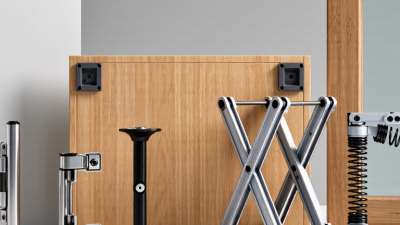
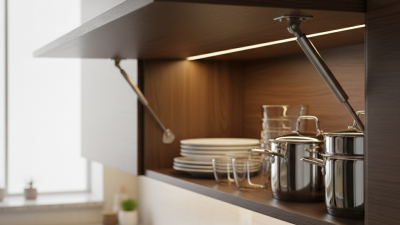
Key Selection Data: 50–1,200 N Force Options, Stroke, and Extended Length

For cabinet supports, 50–1,200 N is a broad selection range, not a direct measure of door weight. A 500 N spring does not automatically suit a 500 N door; hinge position and mounting geometry change the effective lifting force. Check the supplier’s stated force point, often specified at full extension, and confirm whether the figure applies to one spring or a pair. Grand View Research’s Gas Spring Market report estimated the global market at about USD 2.2 billion in 2023, reflecting broad use across furniture and other equipment. Market growth does not replace application-specific testing.

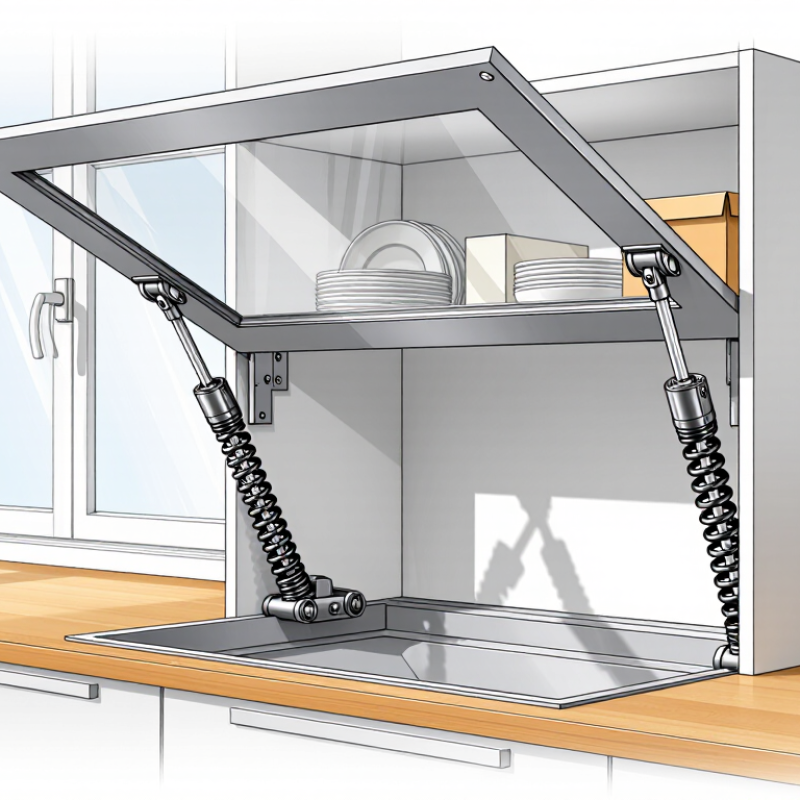
Stroke determines how far the rod travels; extended length is the overall eye-to-eye or fitting-to-fitting dimension when fully open. Measure the cabinet’s available mounting space with the door both open and closed. A 100 mm stroke may still be unsuitable if the extended spring hits a shelf or pushes the door past its intended angle. Check compressed length too. Easy to miss.

Gas pressure changes with temperature: by the ideal gas relationship, a sealed spring warmed from 20°C to 40°C can show roughly 6.8% higher pressure, all else equal. Leave a force margin, especially for heavy doors or cold installations, and test the actual hinge layout. Record door mass, pivot-to-center-of-gravity distance, desired opening angle, and mounting points before comparing options. Measure twice. Real cabinets are rarely perfect.

2026 Gas Spring Cabinet Support Selection

Representative force options across the 50–1,200 N selection range. Force ratings and available increments vary by product; confirm specifications with the supplier.

Selection note: Choose force based on the supported load and mounting geometry. Stroke and extended length are model-specific dimensions, so check the product datasheet and available space before selecting a cabinet support.

Supplier Qualification: ISO 9001, ISO 9227 Salt-Spray Testing, and Cycle-Life Data

For 2026 supplier qualification, request evidence that connects factory controls to the gas spring’s actual performance. ISO 9001:2015 sets requirements for a quality management system; it does not certify a specific spring or guarantee its service life. Ask for a current certificate, its scope, and the issuing body. Then check whether inspection records identify the tested model, production batch, and acceptance criteria.

A certificate alone is not proof.

Salt-spray reports should name the method and conditions. ISO 9227:2022 specifies neutral salt-spray testing with a solution of 50 ± 5 g/L sodium chloride, generally at 35 ± 2°C. Ask suppliers for exposure duration, sample photographs, and any corrosion or coating-failure observations. Chamber hours do not directly predict years of cabinet use. That distinction is easy to miss.

For cycle-life data, request the tested load, stroke, mounting angle, cycle rate, and failure definition. Compare results from the same test setup, and ask how many samples were tested. A headline cycle count without those details is weak evidence. Raw test records may be imperfect, but they reveal more than a polished claim.

2026 Supplier Comparison by MOQ, Lead Time, Customization, and Warranty

2026 Top Gas Spring Cabinet Support Suppliers

A useful supplier comparison starts with the order details, not the headline price. Record each supplier’s minimum order quantity (MOQ), quoted production lead time, sample availability, and warranty terms. The World Bank’s 2023 Logistics Performance Index evaluates 139 economies across six dimensions, including timeliness and shipment tracking. It is a useful reminder that delivery promises depend on logistics as well as factory capacity. Ask whether lead-time estimates include inspection, packing, and transit. A two-week production quote may not mean delivery in two weeks.

Customization affects both fit and schedule. Send a drawing that specifies cabinet-door weight, opening angle, spring force, stroke, and mounting points. Request confirmation that the proposed support has been tested for the intended application. Compare warranty duration alongside what it covers, such as material defects, gas leakage, or operating cycles. Terms vary, so avoid treating warranty length alone as proof of product life. Small batches cost more. A tidy comparison sheet can still miss a detail.

Tips: Request a sample and a written quote for the same specification from every supplier. Ask them to state MOQ breaks, sample fees, production lead time, shipping estimate, and warranty exclusions. Check the mounting holes against a real cabinet panel before approving a bulk order. I would not assume identical force ratings behave identically across different door geometries; that needs a fit check.

2026 Top Gas Spring Cabinet Support Suppliers - 2026 Supplier Comparison by MOQ, Lead Time, Customization, and Warranty

Comparison Criterion Supplier 1 Supplier 2 Supplier 3 Supplier 4
Minimum Order Quantity (MOQ) Not publicly disclosed; confirm for the selected model and order quantity. Not publicly disclosed; confirm for the selected model and order quantity. Not publicly disclosed; confirm for the selected model and order quantity. Not publicly disclosed; confirm for the selected model and order quantity.
Standard Lead Time Not publicly disclosed; request a current estimate for production and shipping. Not publicly disclosed; request a current estimate for production and shipping. Not publicly disclosed; request a current estimate for production and shipping. Not publicly disclosed; request a current estimate for production and shipping.
Customization Confirm available force ratings, dimensions, end fittings, finish, and packaging directly. Confirm available force ratings, dimensions, end fittings, finish, and packaging directly. Confirm available force ratings, dimensions, end fittings, finish, and packaging directly. Confirm available force ratings, dimensions, end fittings, finish, and packaging directly.
Warranty Warranty period and coverage not publicly disclosed; request written terms. Warranty period and coverage not publicly disclosed; request written terms. Warranty period and coverage not publicly disclosed; request written terms. Warranty period and coverage not publicly disclosed; request written terms.
Quotation Verification Obtain a dated quotation specifying model, force, MOQ, lead time, and warranty. Obtain a dated quotation specifying model, force, MOQ, lead time, and warranty. Obtain a dated quotation specifying model, force, MOQ, lead time, and warranty. Obtain a dated quotation specifying model, force, MOQ, lead time, and warranty.

Supplier-specific commercial terms were not provided or independently verified for this comparison. Confirm all figures, product specifications, and warranty conditions directly with each supplier before ordering.

Installation and Safety Checks: Load Pairing, Damping, and Retention

A reliable cabinet support setup begins with accurate load pairing. Weigh the door with its handle and attached hardware, not just the panel. Record its height and pivot position. Ask suppliers for force ratings and mounting guidance that match those details. Two springs do not automatically provide safe support; their combined force must suit the door and installation geometry. Do not guess.

Install the supports with the door securely held open, and follow the supplied mounting dimensions. Check that both sides align and that screws sit firmly in sound material. Move the door through its full travel by hand. It should rise without twisting and close without a sharp slam. Test it slowly. Damping can feel different near the end of travel, so watch for sudden acceleration or resistance.

Retention deserves a close look. Confirm each end fitting is fully seated and its retaining clip is engaged. Keep fingers clear of hinges and spring joints during checks. Leave the door open briefly, then inspect for slipping, loose fasteners, or uneven gaps. A quiet test can fool you. Repeat the check after several cycles; small shifts may appear only once the parts settle. If the door drifts or drops, stop using it until the load match and attachments are reviewed.