Buying a Glass Clamp for an international project is more complex than comparing unit prices. The right choice must support safety, durability, appearance, and installation efficiency. Global buyers often source clamps for balustrades, shower enclosures, partitions, staircases, and display systems. Each application creates different demands.
This guide presents ten practical buying tips based on common sourcing and installation considerations. It examines material grades, surface finishes, glass thickness, load requirements, and fitting compatibility. It also considers supplier experience, product testing, technical drawings, packaging quality, and after-sales support. A clamp that looks polished in a catalog may still fail during installation if its dimensions are unclear. Small details matter.
Check the supplier’s manufacturing records and request traceable quality documents. Confirm whether stainless steel, aluminum, or another material suits the environment. Coastal projects need stronger corrosion resistance. Busy commercial spaces need reliable fastening and repeated-use performance. Local building requirements should also be reviewed before ordering. Requirements vary.
Do not ignore samples. A physical sample can reveal sharp edges, weak threads, uneven polishing, or poor alignment. It may also expose assumptions in your original specification. No checklist is flawless. Buyers should compare technical data with real project conditions, not marketing language alone. Careful communication can reduce delays, replacement costs, and safety concerns across borders. The following tips help purchasing teams make clearer, more reliable Glass Clamp decisions.
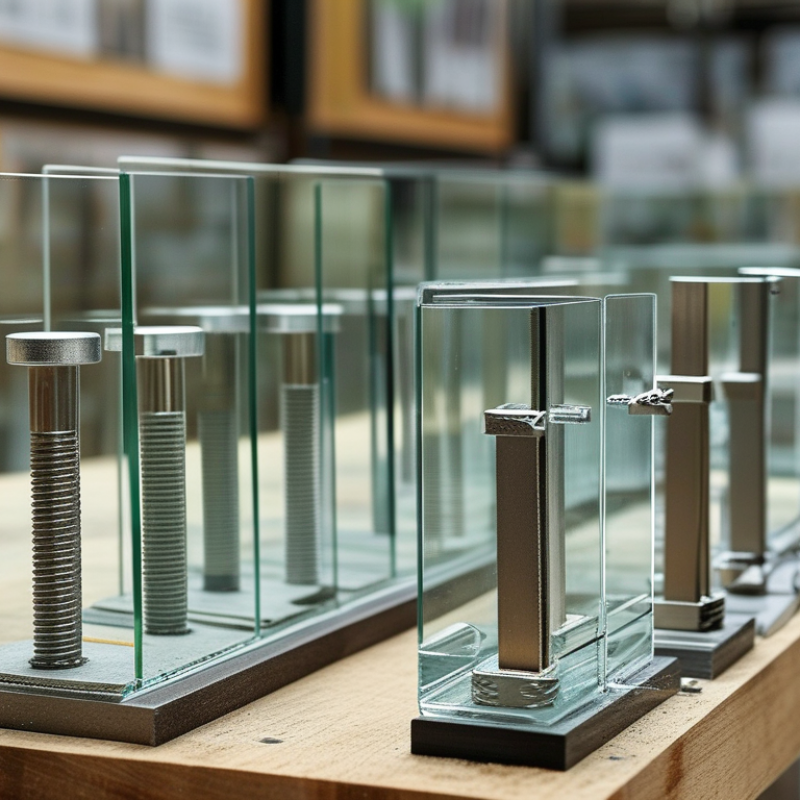
Glass clamps are not interchangeable. A 90-degree clamp joins glass to a wall, while a 180-degree clamp connects aligned panels. Adjustable clamps help correct small installation errors. U-channel systems provide continuous support and suit shower screens, partitions, and low-risk interior panels. Point-fixed fittings create a lighter appearance, but they demand accurate drilling and stronger engineering control.
I have seen attractive fittings fail because buyers ignored glass thickness. Check whether the panel is tempered or laminated before selecting a clamp. Tempered glass commonly follows EN 12150, while laminated glass follows EN 14449. The clamp must match the glass edge, hole diameter, load, and fixing substrate. Outdoor balustrades need corrosion-resistant materials and drainage details. Poolside applications need better resistance to moisture and cleaning chemicals. Small details matter.
The 2023 UNEP Global Status Report states that buildings consume about 30% of global final energy. This supports careful facade and partition design, where daylight and durable hardware can reduce replacement needs. Still, this figure does not prove that every glass clamp improves energy performance. That would be an overstatement. Ask for test reports covering load capacity, salt spray, cyclic movement, and installation torque. A clamp may look solid. It may still be unsuitable. Always compare the intended application with local structural requirements and the supplier’s verified data.

10 Glass Clamp Buying Tips for Global Buyers
Material choice shapes a clamp’s service life. Stainless steel is common, but grades behave differently in real environments. Grade 304 suits many indoor projects with low humidity. Grade 316 offers stronger resistance near seawater, pools, and de-icing salts. It is not automatically corrosion-proof. Ask for material certificates, chemical composition, and traceability for each production batch.
Inspect the finish under bright light. A smooth, even polish reduces dirt retention around welds and corners. Brushed surfaces can hide small scratches, so check them from several angles. Painted or coated clamps need adhesion testing, especially around fastener holes. PVD finishes may look impressive, but poor preparation can cause early peeling. Request sample pieces and rub them with a clean cloth. Small details matter.
Corrosion usually starts in overlooked places. Check weld seams, internal cavities, screw threads, and contact points beneath rubber pads. Confirm that pad materials will not stain, harden, or react with the glass. In coastal installations, ask for salt-spray data, but read it carefully. Laboratory hours do not perfectly predict outdoor performance. Review installation photographs from similar climates. A supplier should explain cleaning methods, inspection intervals, and replacement parts. Do not accept vague claims such as “premium stainless steel.” A slightly imperfect sample can reveal more than a polished catalogue image.
Clamp selection should begin with the glass, not the catalogue photo. The National Glass Association’s Glass Technical Paper on Glass Weight and Thickness uses approximately 2.5 kg per square metre for every millimetre of glass thickness. A 10 mm panel therefore weighs about 25 kg per square metre, before fittings or wind pressure. Measure the actual glass with a caliper. “10 mm” can become unsafe when tolerances, coatings, or laminated layers are ignored. Confirm the clamp’s internal opening, gasket range, jaw depth, and edge clearance. A loose gasket allows movement. An over-tightened screw can create local stress.
Load capacity also needs context.
ASTM E1300 evaluates glass resistance under specified loads, but it does not approve every clamp installation. Check panel width, height, span, support points, wind exposure, impact risk, and the clamp manufacturer’s tested capacity. The National Glass Association recommends considering dead load, live load, and environmental forces separately in glazing design guidance. Ask for test reports, allowable working loads, and the safety factor used. Do not compare a breaking load with a working load. That mistake is common. For outdoor barriers, local building requirements may demand laminated safety glass and engineered fixing details. A clamp rated for 12 mm glass is not automatically suitable for 12.76 mm laminated glass. Record the measured thickness, clamp spacing, fastener substrate, and torque during installation. Recheck them later; installation conditions are rarely perfect.
10 Glass Clamp Buying Tips for Global Buyers
A reliable buying screen covers ten checks: applicable safety standards, tested load ratings, glass compatibility, edge clearance, fastener grade, corrosion resistance, torque limits, installation access, inspection records, and traceability. Ask for test reports, not polished claims. Tempered glass should match the required standard, such as EN 12150 or ANSI Z97.1, depending on the destination market. Clamp bodies must distribute pressure evenly; sharp set-screw contact can create hidden stress. Request drawings showing pad thickness, hole spacing, and minimum glass edge distance. Small details matter.
Installation evidence is equally important. Review torque instructions, tightening tools, and replacement-part availability. A useful supplier should explain how installers prevent over-tightening on site. Request samples with visible markings, batch numbers, and corrosion-test results. ISO 12100-style risk thinking can reveal pinch points and falling-glass hazards before approval. The 2023 ISO Survey recorded 1,265,216 ISO 9001 certificates worldwide, yet certification alone does not prove clamp performance. It only supports process confidence.
Market scale also increases sourcing risk. Grand View Research valued the global flat glass market at about USD 142.4 billion in 2023, with projected growth through 2030. More suppliers do not mean equal control. Compare material certificates, coating thickness, dimensional inspection data, and failed-test records. I would still inspect a production sample independently. A supplier may provide complete documents, but one missing torque value can weaken the entire installation decision.
| No. | Buying Dimension | What to Verify | Practical Acceptance Criteria | Documents or Evidence to Request | Risk if Neglected |
|---|---|---|---|---|---|
| 1 | Glass Compatibility | Confirm that the clamp is designed for the actual glass type, thickness, edge condition, and application. | The clamp opening matches the specified glass thickness without forcing, excessive clearance, or edge contact. | Dimensional drawing, approved glass specification, and installation instructions. | Glass damage, slipping, uneven loading, or clamp failure. |
| 2 | Safety Glass Verification | Check whether the project requires tempered, heat-strengthened, or laminated safety glass. | Request evidence aligned with the applicable jurisdiction, such as EN 12150 for thermally toughened glass, EN 14449 for laminated glass, ASTM C1048 for heat-treated flat glass, or ASTM C1172 for laminated architectural flat glass. | Mill certificate, conformity declaration, test report, or batch traceability record. | Non-compliance with building regulations and increased injury exposure. |
| 3 | Structural Load Capacity | Review the clamp’s tested load capacity for the intended dead load, wind load, impact load, and safety factor. | The rated capacity is supported by testing or engineering calculations for the complete glass-and-clamp assembly, not only the clamp body. | Load-test report, engineering calculation, test setup, and permitted installation configuration. | Overloading, excessive deflection, loosening, or structural failure. |
| 4 | Material and Corrosion Resistance | Identify the base metal, surface treatment, and suitability for indoor, outdoor, coastal, or high-humidity environments. | Material grade and finish are stated clearly; outdoor and coastal projects require a corrosion-resistance assessment appropriate to the exposure category. | Material certificate, coating or plating specification, salt-spray report where relevant, and finish sample. | Rust, staining, thread seizure, and reduced service life. |
| 5 | Glass Protection Features | Check for resilient liners, setting pads, insulating washers, and controlled contact surfaces. | No direct metal-to-glass contact; liners are continuous, correctly positioned, chemically compatible, and replaceable when specified. | Cross-sectional drawing, liner material information, and sample assembly. | Point loading, glass chipping, stress concentration, or premature cracking. |
| 6 | Installation and Adjustment | Evaluate access for leveling, alignment, tightening, replacement, and final inspection. | Installation instructions specify screw sequence, tightening method, glass gap, allowable adjustment, and required tools. | Installation manual, exploded view, torque guidance, and approved fixing details. | Uneven clamping, misalignment, over-tightening, or difficult maintenance. |
| 7 | Fasteners and Substrate Fixing | Verify the fixing method for concrete, steel, timber, masonry, or other supporting substrates. | Anchor type, embedment, edge distance, hole diameter, and fixing spacing are defined by the project engineer or approved system design. | Anchor data sheet, fixing schedule, substrate requirements, and pull-out or shear calculations when required. | Anchor pull-out, substrate cracking, movement, or local failure. |
| 8 | Dimensional and Surface Quality | Inspect critical dimensions, threads, mating faces, edges, finish consistency, and burr removal. | Critical dimensions comply with the approved drawing; threads operate smoothly; contact faces are flat and free from burrs, cracks, pits, and sharp edges. | Inspection plan, dimensional report, surface-finish standard, and approved pre-production sample. | Installation difficulty, cosmetic defects, uneven pressure, or unreliable tightening. |
| 9 | Quality Control and Traceability | Confirm that production batches can be identified and inspected consistently. | Each batch has traceable raw material, production date, inspection records, and defined sampling or 100% inspection requirements for critical features. | Quality-control plan, batch inspection report, material traceability record, and nonconformance procedure. | Mixed quality, difficult recalls, inconsistent fit, or unverified replacement parts. |
| 10 | Packaging, Logistics, and After-Sales Support | Assess protection against impact, moisture, scratching, missing components, and installation errors during international shipment. | Every kit is labeled with part numbers and quantities; liners, screws, washers, and instructions are protected and easy to reconcile on receipt. | Packing list, packaging specification, spare-parts list, warranty terms, and replacement procedure. | Transit damage, incomplete installation, project delays, or costly field replacement. |
Note: The applicable safety requirements depend on the project location, building type, glass configuration, supporting structure, and local regulations. Final selection should be confirmed by a qualified project engineer.
Global buyers should compare glass clamp suppliers beyond catalog prices. Ask for stainless-steel grade, load testing, surface-finish records, and installation instructions. Request recent inspection reports and sample photographs. The World Bank’s 2023 Logistics Performance Index evaluates customs, infrastructure, shipment quality, and timeliness. These factors often explain why a cheaper quotation arrives later or requires rework.
Tip: Compare like with like. Include clamp size, glass thickness, rubber gasket type, corrosion resistance, packaging, and testing in every request. Custom designs need clearer drawings, tolerances, and prototype approval. I have found that small changes, such as a concealed screw or unusual glass angle, can alter tooling costs quickly. That detail is easy to underestimate. Suppliers should state minimum order quantities, sample charges, and revision fees before production.
Pricing also needs a landed-cost view. Add tooling, export packaging, freight, insurance, duties, bank charges, and possible inspection costs. UNCTAD’s Review of Maritime Transport 2024 reported 2.4% growth in global maritime trade during 2023, while disruptions continued to pressure routes and schedules. Therefore, request both an estimated shipping date and a latest acceptable date. Use milestone payments linked to approved samples and pre-shipment inspection. A written tolerance for delivery delays is practical, although it may not feel friendly. Delivery terms should name the Incoterms rule, transfer point, documents supplied, and responsibility for damage. Mistakes still happen, even with careful contracts.